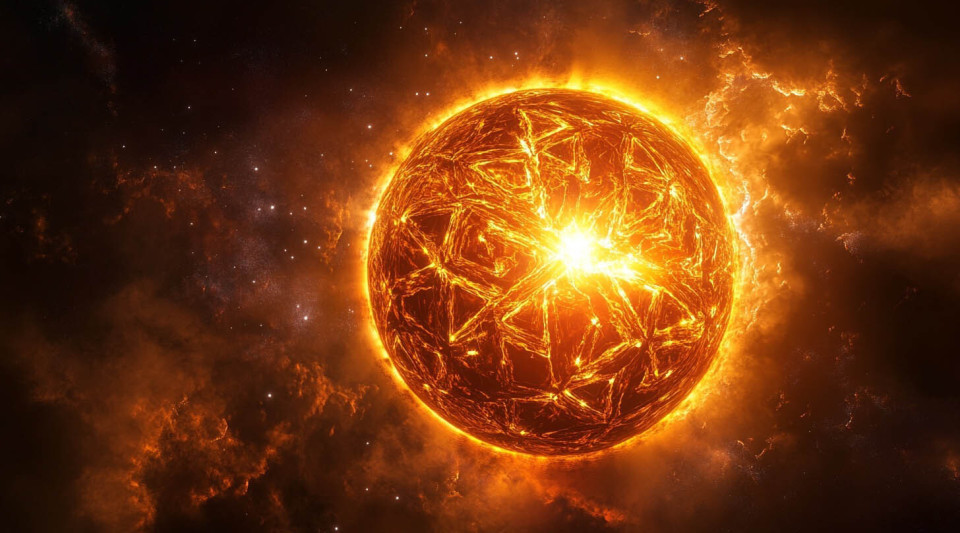
If you’ve ever read about Dyson spheres, you’ve probably heard about their “fatal flaw”: a solid Dyson sphere is physically unstable.
The reasoning is simple — Newton’s shell theorem tells us that the gravitational forces inside a hollow sphere cancel out everywhere. This means nothing is “tethering” the sphere to the star. The Sun and the sphere can drift in different directions, and the result is that the star will eventually crash into the sphere’s inner wall, destroying it.
Freeman Dyson knew this when he proposed the concept in 1960 — which is why he never imagined a solid shell, but a swarm of independent orbiting satellites (a “Dyson swarm”). The “solid Dyson sphere” was popularized later by science fiction.
But in January 2025, engineer Colin McInnes of the University of Glasgow published a paper in the Monthly Notices of the Royal Astronomical Society with a straightforward title: “Ringworlds and Dyson Spheres Can Be Stable.”
This was a game-changer.

Part 1: The Key Breakthrough — Binary Star Systems
McInnes’ discovery is rooted in a classic celestial mechanics problem: the circular restricted three-body problem.
In this model, two massive bodies (e.g., two stars) orbit their common center of mass in a circular orbit, and a third, less massive body (e.g., the Dyson sphere you’re placing) moves under their gravitational influence. Within such systems, there are five special equilibrium points — the Lagrange points. Among them, L4 and L5 are stable when the mass ratio is small enough.
McInnes inserted a Dyson sphere into this framework and found a configuration where it can remain stable: in a binary star system, if one star is much smaller than the other (with a mass no more than one-tenth of the larger star), the Dyson sphere can enclose the smaller of the two stars.
The smaller star’s motion acts like a “gravitational anchor,” pulling the Dyson sphere to orbit the larger star at the same rate, preventing catastrophic collisions.
The key condition is: the Dyson sphere itself must be extremely lightweight and thin — otherwise, its own gravity would disrupt the system’s dynamics and break stability. Also, this model only addresses “gravitational stability” — it doesn’t touch on engineering challenges like material stress, structural strength, or how you’d actually build the thing.
Part 2: Why Does This Matter?
This paper overturns the long-held consensus that “a solid Dyson sphere cannot be stable.” One peer reviewer noted: “The results reveal a tantalizing glimpse of a universe where Dyson spheres may not be confined to science fiction.”
More importantly, it gives astrobiologists and SETI researchers a new direction. If alien civilizations did the same physics calculations before building their Dyson spheres, they wouldn’t build them around single stars — they’d build them in binary systems.
What should astronomers look for? A large, bright star with a diffuse infrared companion nearby — that would be the waste heat leaking from a Dyson sphere wrapped around the smaller star.
Part 3: What Does This Have to Do With Real Dyson Sphere Searches?
After this stability paper was published, the “Project Hephaistos” research also came into the spotlight. This project is already analyzing real astronomical data to look for potential Dyson spheres.
They screened 5 million celestial objects, combining optical data from the Gaia satellite with infrared data from 2MASS and WISE. The result: they found seven promising candidate objects worth further investigation.
All seven candidates are M-type red dwarf stars — and they show unusual “infrared excess” emission. That means something besides the star itself is generating heat — and it’s hard to explain using known astrophysical phenomena.
Why red dwarfs specifically? Because red dwarfs are small, long-lived, and the most common type of star in the universe. From an engineering perspective, their lower mass makes the mass-ratio condition easier to satisfy — which makes them better candidates for building Dyson spheres.
Part 4: One Thought to Take Away
What’s most fascinating about this paper isn’t that it proves “Dyson spheres are possible.”
It’s a reminder that our “impossibilities” are often just “impossible within this specific framework.”
Newton’s shell theorem says a Dyson sphere in a single-star system is unstable — that’s correct. But the majority of stars in the universe are not single stars. Over half of all stars are in binary or multi-star systems. McInnes didn’t reinvent physics. He just switched frameworks — redefining the problem from “a shell enclosing a star” to “the dynamics of a shell in a three-body gravitational field.”
That’s not overthrowing physics. It’s putting the problem into a larger equation and arriving at a different answer.
The paper’s conclusion lands in an interesting place: it acknowledges that “the likelihood of humanity building a Dyson sphere in the foreseeable future is extremely low,” but also says that “this can help provide direction for the search for extraterrestrial intelligence.” What it really solves is a more fundamental question: if there are civilizations out there advanced enough, where would they build their Dyson spheres?
Maybe, somewhere in the universe, there really is a civilization in a binary system — using the smaller star’s gravity as an anchor, building its Dyson sphere right now. And we — through our infrared telescopes — might just be seeing them without realizing it.
Do you think aliens would build Dyson spheres around single stars or binary stars? Let me know in the comments.