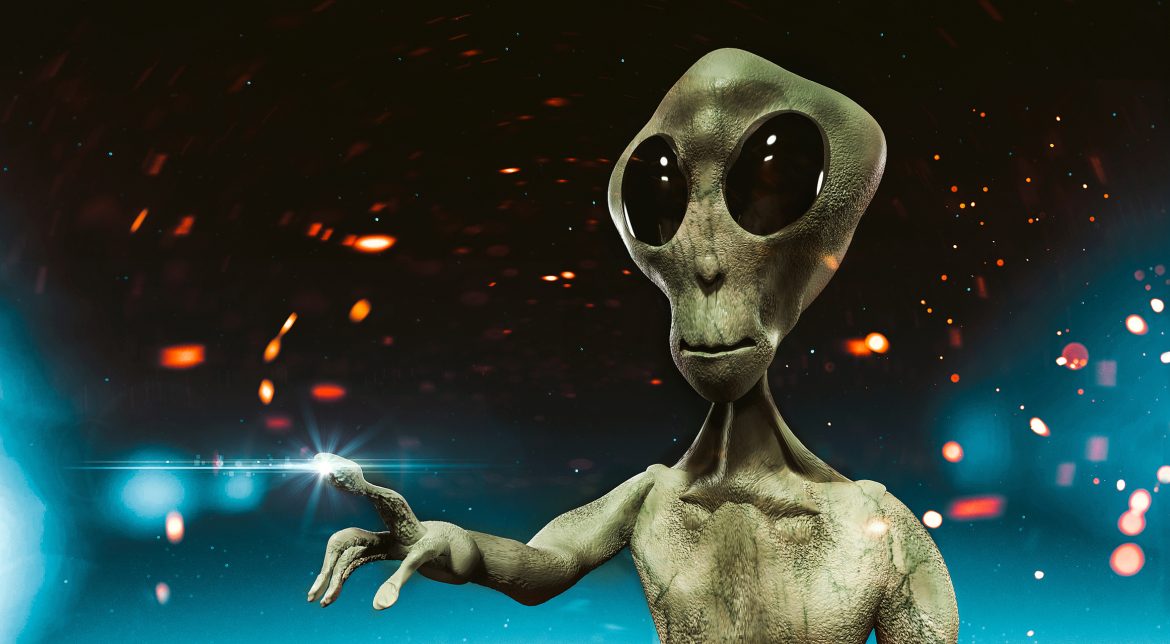
For generations, science fiction has shaped how we imagine aliens. Bug-eyed monsters. Tall, bald, grey-skinned humanoids. Slimy creatures with too many teeth. The xenomorph from Alien. The heptapods from Arrival. The list goes on.
But here’s the thing: Hollywood gets it wrong. And scientists have been saying so for decades.
The problem isn’t that filmmakers lack imagination. It’s that they have to put actors in suits. Real aliens — if they exist — probably look nothing like us. And the science of evolution, biology, and physics can actually tell us a lot about what they might look like.
Let me walk you through what scientists are actually saying.
Part 1: The Biggest Misconception — Aliens Are Probably Not Humanoid
“The biggest misconception people have is that aliens are going to look like they do in the movies,” says Professor Jon Willis, an astronomer at the University of Victoria .
And he’s right. Almost every Hollywood alien is just a human with makeup. Two arms. Two legs. Two eyes. A head. A face.
But think about it: why would a creature that evolved on an entirely different planet — with different gravity, different atmosphere, different chemistry, different evolutionary pressures — end up looking anything like us?
SETI scientist Seth Shostak put it bluntly: “Why would aliens look like us? Apart from apes, no other creature does” .
The reality is that life on Earth is incredibly diverse, and that’s just on one planet. Even within Earth’s life forms, the range of body plans is staggering — from jellyfish to elephants, from bacteria to whales. Why would aliens be limited to the narrow range that looks human?
The biology of alien worlds would be shaped by their own unique environments, not by human evolution. Gravity, atmospheric pressure, temperature, available resources, and the specific chemistry of their planet would all drive evolution in completely different directions .

Part 2: What Scientists Can Predict — The Universal Rules
Despite all this uncertainty, scientists aren’t completely in the dark. There are some principles that seem to hold up — because the laws of chemistry and physics are the same everywhere in the universe .
Symmetry Is Likely (But Not in the Way You Think)
Most scientists agree: alien life will probably be symmetrical.
Virtually all complex life on Earth has bilateral symmetry — a left and right side that mirror each other. Why? Because it’s an efficient way to build a body .
But here’s the twist: some aliens might have radial symmetry (like a starfish, with no left or right, just top and bottom). Or even modular organization — like insects, with repeated segments .
As one SETI researcher put it, “An organism with radial symmetry has no left or right sides, only a top and a bottom. The type of symmetry would be influenced by the environment in which it lived” .

Gravity Dictates Height and Build
Here’s something that’s relatively easy to predict: an alien’s size and proportions depend largely on the gravity of its home planet.
On a planet with high gravity, creatures would need thicker, stronger bones to support their weight. They’d be squatter, stockier, built closer to the ground. Think more “tank” than “giraffe” .
On a planet with low gravity, creatures could grow much taller and leaner. A human on a low-gravity world could easily stand 5 meters tall with relatively thin bones .
They’ll Need Sensors and Manipulators
For a creature to be “intelligent” in the way we understand it, two things are almost certainly required :
- Some way to manipulate the environment — hands, tentacles, claws, or trunks. You can’t build a civilization without picking things up.
- Some way to sense the environment — eyes, ears, or something equivalent. You can’t navigate or communicate without sensing.
Cambridge paleontologist Simon Conway Morris argues that convergent evolution — where different species independently evolve similar solutions to similar problems — might be universal . Eyes have evolved independently on Earth at least 50 times. Intelligence, limbs, and language might be inevitable on any planet where complex life develops.
But the form those sensors and manipulators take? That’s where things get weird.
Part 3: The Really Weird Possibilities — Beyond Humanoid
Here’s where science gets interesting. Aliens might be far stranger than anything we’ve put on screen.
Silicon-Based Life
All life on Earth is carbon-based. But carbon isn’t the only element that could serve as the backbone of complex molecules.
Silicon is the most likely alternative. It sits right below carbon on the periodic table and can form similar bonds. But there’s a catch: silicon is far less stable than carbon. It reacts easily with oxygen and water, forming silicates — basically sand and rocks .
For silicon-based life to exist, the planet would need to be very different from Earth: extremely high temperatures, and an environment without water or oxygen. If it did exist, silicon life forms might be crystalline in structure, incredibly slow-moving, and possibly living in molten environments .
We might not even recognize them as alive.
Extremophiles and Simple Life
Astrobiologists like André Antunes, a microbiologist at the University of Saint Joseph in Macao, argue that the most common form of alien life is probably microbial — not the big, intelligent creatures we imagine .
“Peoples’ imaginations have been populated with this scenario of little green men for such a long time,” Antunes says. But scientists suspect that simpler organisms are far more common in the cosmos .
This isn’t just speculation. On Earth, microbial life thrives in conditions that would kill anything larger: deep under the ocean, beneath polar ice, in ultra-salty lakes, and even in the stratosphere miles above the surface .
If we find life elsewhere in the solar system — on Mars, on Europa (Jupiter’s moon), or Enceladus (Saturn’s moon) — it’s far more likely to be microbial than a spacefaring civilization .
Floaters and Other Extreme Body Plans
In 1976, Carl Sagan and Edwin Salpeter proposed a truly radical idea: on gas giant planets like Jupiter, life might take the form of “floaters” — thin, gas-filled balloons floating in the dense atmosphere .
These creatures could be anything from 1 meter to 1 kilometer in diameter, drifting in the clouds, feeding through photosynthesis or chemical reactions. They wouldn’t need legs, eyes, or anything we’d recognize as a body plan .
Other scientists have proposed “amorphous organisms” that attach to seabeds or float in layers of water, or “vertically floating, cigar-shaped organisms” that tap heat energy from different layers of a gas giant’s atmosphere .
The Crabs Might Be Coming
Here’s a fun thought: evolution on Earth has independently produced crab-like body plans multiple times — a phenomenon known as carcinization.
A 2025 paper from the University of Leicester asked an intriguing question: if crabs keep appearing on Earth, could they be a universal evolutionary outcome? .
The paper suggests that the crab-like body plan — compact, well-armored, efficient — offers significant advantages. If alien worlds have similar environmental pressures, they might have their own versions of crabs .
But don’t expect your standard Earth crab. These would be “alien crabs” — adapted to their own worlds, perhaps with wildly different chemistries and sizes.

Part 4: The Challenge of Communication — Even If They’re Out There
There’s one more layer to this question that most people don’t consider.
Even if aliens exist, even if they’re intelligent, even if they’re trying to communicate — we might not recognize the signals.
“We should be aware of any claim that we think like aliens do,” says Jon Willis .
Imagine an alien civilization that thinks on time scales of tens of thousands of years. A signal that flashes once every 10,000 years might be perfectly obvious to them — and completely invisible to us .
Or consider that 95% of the universe is made of dark matter and dark energy — stuff we can’t see or measure with current technology. As TV producer Darren Campo put it: “One could say that the majority of aliens cannot be seen, because they’re in places that we can’t perceive” .
Microbiologist André Antunes puts it another way: “I think it’s cool when you think a little bit outside of the box” .
Project CETI (Cetacean Translation Initiative) is taking exactly this approach. They’re studying sperm whale communication — a form of “alien” intelligence right here on Earth — to develop translation tools that could one day be applied to extraterrestrials .
Part 5: One Thought to Take Away
The next time you watch a sci-fi movie with humanoid aliens, remember: the director just needed an actor in a suit.
The real aliens are almost certainly stranger than anything we’ve imagined. They might be microbial. They might be crystalline. They might float in gas clouds or live in sulfuric acid. They might be crabs.
But the laws of physics and chemistry do give us some clues. Symmetrical bodies. Sensors for light. Manipulators for tools. Adaptations to gravity. These aren’t guaranteed — but they’re good starting points.
One thing scientists agree on: Hollywood’s little green men are almost certainly wrong.
And honestly? That’s way more interesting than another human with pointy ears.
What do you think aliens actually look like? Or do you side with the scientists who think they’re probably just microbes? Let me know in the comments.