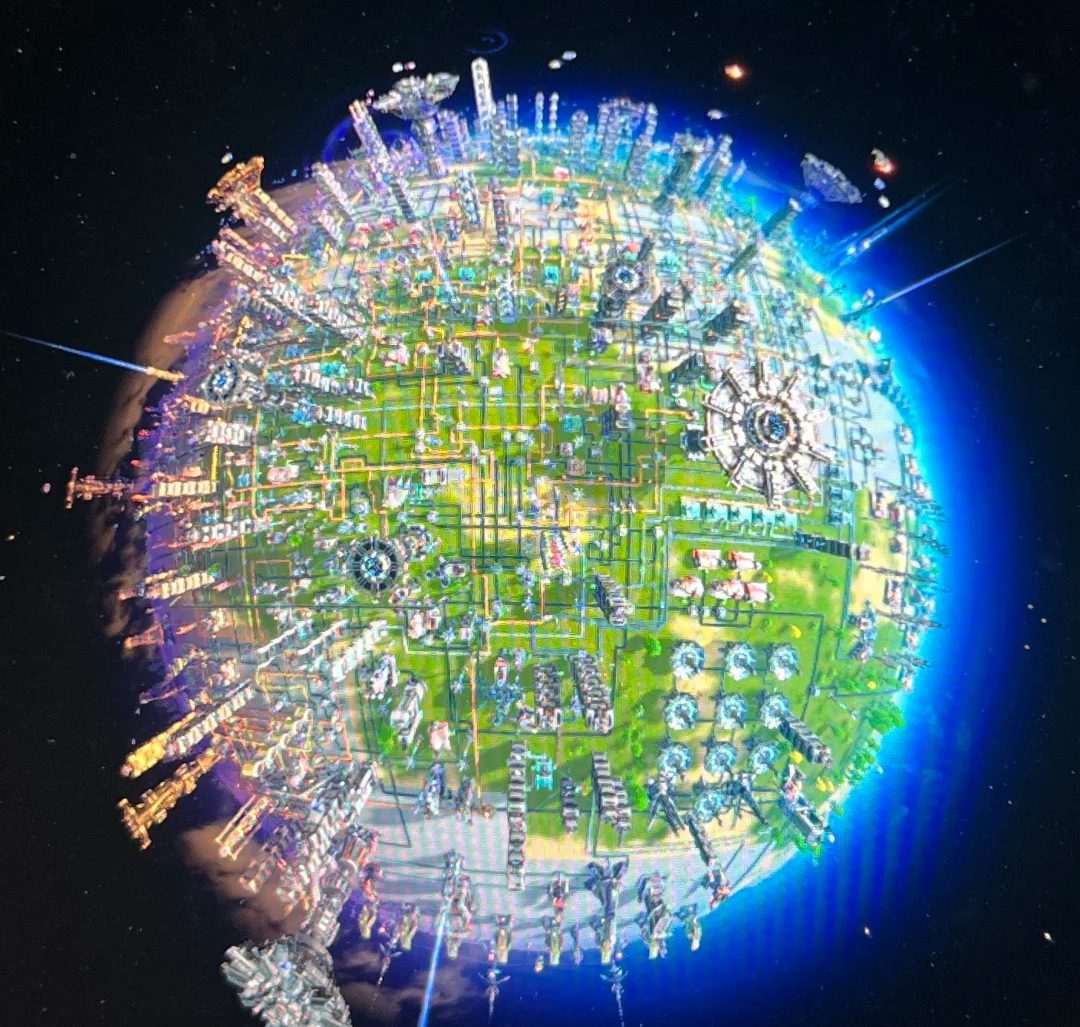
Let me start with a number that will make your head spin.
If you wanted to build a solid Dyson sphere around the Sun — a rigid shell at Earth’s orbit, just 1 meter thick — you would need enough material to fill a volume of 2.8 × 10²³ cubic meters .
That’s about 380 Earths worth of mass .
Or roughly 2.3 × 10²⁴ kilograms — if you built it out of steel .
The entire solar system, minus the Sun, has a mass of about 2.8 × 10²⁷ kg. So in theory, there’s enough material. But here’s the catch: you’d have to take apart every planet, moon, and asteroid in the solar system to get it.
Including Earth.
That’s not a construction project. That’s a civilization ending its own existence to build a really big power plant.
So today, I want to walk you through what the math actually says — and why physicists think a full Dyson sphere is probably impossible, but a smaller version might just be within the realm of science fiction.

Part 1: The Hard Numbers — What Would It Take?
Let’s start with something you can actually visualize.
A Dyson sphere built at 1 astronomical unit (Earth’s orbital radius) would have a surface area of about 2.8 × 10²³ square meters . That’s roughly 600 million times the surface area of Earth.
If you made the shell 1 meter thick, you’d need 2.8 × 10²³ cubic meters of material .
Using steel as a reference (density ~8,000 kg/m³), the total mass would be about 2.3 × 10²⁴ kg .
Here’s a comparison to put that in perspective:
- Earth’s mass: 6 × 10²⁴ kg — so you’d need about 380 Earths worth of material
- Jupiter’s mass: 1.9 × 10²⁷ kg — so even the largest planet in the solar system has more than enough, but you can’t exactly “use” a gas giant the way you’d use a rocky planet
So the materials are technically there. The total mass of all planets, moons, and asteroids in the solar system is about 2.8 × 10²⁷ kg . That’s enough to build multiple Dyson spheres — if you were willing to dismantle everything.
Part 2: The Silicon Problem — A More Realistic Look
A 2025 study from Forschungszentrum Jülich in Germany took a more practical approach. Instead of imagining a steel shell, they asked: what if we built a photovoltaic Dyson sphere out of silicon — the material we actually use to make solar panels?
Silicon is the second most abundant element in Earth’s crust. But would there be enough of it?
According to the study, Earth contains about 9 × 10²³ kg of silicon . Venus probably has a similar amount. Mars has about 1.1 × 10²³ kg. The Moon has roughly 1.5 × 10²² kg .
For a full Dyson sphere extending to Saturn’s orbit (about 9.5 AU) with a 50-micrometer-thick solar cell layer — thinner than a human hair — the silicon requirement would be 1.2 × 10²⁵ kg .
That’s about 1% of all the silicon in the entire solar system — but more than 10 times the silicon found on Earth or Venus alone .
So a full sphere? Not happening with our current understanding of material availability.
Part 3: The Partial Sphere — A More Plausible Alternative
Here’s where things get interesting.
The Jülich study didn’t stop at the “full sphere is impossible” conclusion. Instead, they calculated what a partial Dyson sphere — more like a swarm of orbiting solar collectors — would require .
Their proposal: a partial sphere at 2.13 astronomical units (farther out than Mars, about halfway to the asteroid belt), covering 22% of the sphere’s surface .
The silicon requirement: 1.3 × 10²³ kg .
That’s roughly the amount of silicon estimated to be on Mars .
Suddenly, we’re not talking about dismantling Earth. We’re talking about mining a single planet — still a monumental undertaking, but within the realm of theoretical possibility.
And the payoff? This partial sphere could generate 15.6 yottawatts of electricity — about 4% of the Sun’s total energy output .
To put that in perspective: that’s enough energy to accelerate a 1,000-ton spacecraft to 90% of the speed of light in just 7.5 milliseconds .
Part 4: Where Would the Material Actually Come From?
So if we’re going to build anything like a Dyson sphere — even a partial one — where do we get the materials?
Mercury: The Obvious First Choice
Mercury is the prime candidate for several reasons :
- It’s the closest planet to the Sun, so moving materials to their final orbit costs less energy.
- It has a high metal content (iron, nickel) — about 70% metal by mass .
- Its low gravity makes launching materials into space relatively easy.
- It has no atmosphere or biosphere to worry about.
A 2023 paper from the Future of Humanity Institute at Oxford University estimated that a fully automated mining operation on Mercury could disassemble the entire planet in about 31 years .

Venus, Earth, Mars, and the Asteroid Belt
If Mercury isn’t enough, the next targets would be:
- Venus: Similar silicon content to Earth — about 1.1 × 10²³ kg of silicon .
- Mars: About 1.1 × 10²³ kg of silicon — enough for the partial sphere proposal .
- The asteroid belt: Contains vast amounts of metal, but the total mass is only about 3 × 10²¹ kg — less than 1% of what’s needed .
But here’s the ethical and practical problem: dismantling Venus or Mars might be acceptable in a distant future. Dismantling Earth? That’s where you live.
Part 5: The Real Problem — Not Just Material
Even if we could somehow gather the materials, there are deeper problems.
Thermal Management
A Dyson sphere isn’t just a structure — it’s a radiator.
If you built a full sphere around the Sun, it would absorb all of the Sun’s energy. That energy has to go somewhere. According to the Jülich study, a sphere just outside Earth’s orbit would reach about 400 K (127°C) .
But here’s the problem for Earth: if the sphere is built beyond Earth’s orbit, it would re-radiate heat back toward the inner solar system. Earth’s temperature would rise by about 140 K — making life impossible .
To keep Earth habitable, you’d need to build the sphere at least 8.2 AU (between Jupiter and Saturn), where it would raise Earth’s temperature by only 4 K — a problem, but perhaps manageable .
Structural Stability
The classic “solid shell” Dyson sphere is actually physically impossible to keep stable . Newton’s shell theorem tells us that a hollow sphere experiences no net gravitational force from the mass inside it — but the sphere itself would need to be held together by enormous structural forces that no known material can withstand.
That’s why Freeman Dyson’s original 1960 paper didn’t actually propose a solid shell. He proposed a swarm of independent orbiting satellites . The “solid sphere” version was popularized by science fiction, not physics.
Part 6: What’s the Bottom Line?
Let me give you an honest answer.
A full, solid Dyson sphere around the Sun is almost certainly impossible with any material we know of or can imagine. The material requirements are astronomical — quite literally. And even if you had the material, the structural and thermal problems would likely make it impossible.
But a Dyson swarm — a vast collection of orbiting solar collectors — could theoretically be built with resources from Mercury or Mars . It would take centuries, require technologies we don’t yet have, and demand a level of planetary-scale engineering that makes the pyramids look like sandcastles.
But it’s not ruled out by the laws of physics.
And that’s why physicists are still taking it seriously.
Part 7: One Thought to Take Away
Here’s what I find most interesting about this whole question.
The Dyson sphere isn’t really about materials or energy. It’s about ambition.
It’s a thought experiment that asks: what would it take for a civilization to decide that harnessing a star’s entire energy output is worth the cost of dismantling entire planets?
And the answer tells us something about ourselves.
Right now, we’re a Type 0.7 civilization . We can’t even fully harness the energy of one planet. The idea of building a Dyson sphere is so far beyond our current capabilities that it’s almost meaningless to talk about “how much material” — because the technology, the organization, and the sheer willpower required are just as distant as the raw materials.
But maybe that’s the point.
The Dyson sphere isn’t a blueprint. It’s a reminder of how far we have to go. A target on the horizon. A vision of what a civilization could become — if it survives long enough to reach for it.
If you had to dismantle one planet to build a Dyson sphere — which one would you choose? Let me know in the comments.