All life on Earth competes — that’s what Darwin taught us. But science fiction offers another possibility: what if the endpoint of civilization isn’t competition, but symbiosis?
“Symbiotic civilization” — humans merging with alien life, bodies being transformed, entire planets becoming a single living organism — this is sci-fi’s most subversive challenge to “human exceptionalism.” It asks a question more fundamental than “can we defeat aliens”: what if the line between “us” and “them” never existed in the first place?
Part 1: Interspecies Symbiosis — Dinosaurs and Ants Building a Civilization Together
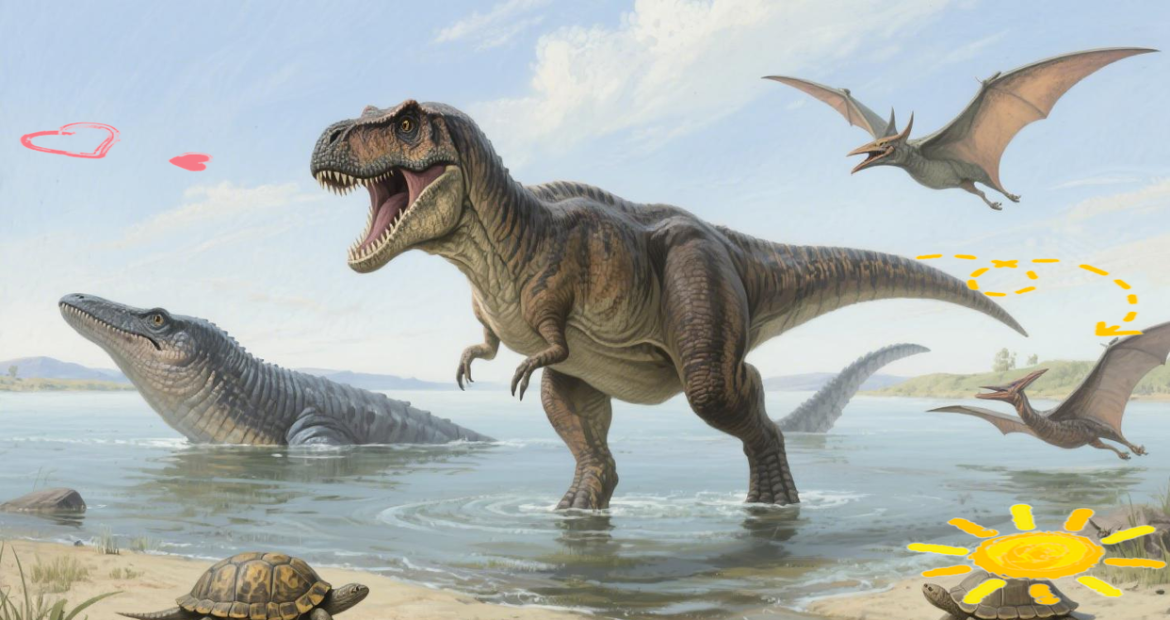
In his novella Of Ants and Dinosaurs, Liu Cixin conducts a thought experiment: what if dinosaurs and ants built a civilization together?
Dinosaurs had immense bodies and strength, but their claws were too clumsy to make fine tools. Ants were tiny — but they were smart, dexterous, and could cooperate through division of labor. So two completely different species — one weighing tens of tons, the other less than a gram — began an accidental collaboration, eventually creating a “Dino-Ant civilization.”
This civilization had cities, technology, and even reached the space age. But here’s the problem: what held this civilization together wasn’t love — it was mutual dependence.
Dinosaurs needed ants for fine manipulation. Ants needed dinosaurs for protection and energy. This collaboration lasted thousands of years — until religious conflicts and ecological crises tore the fragile balance apart, and the two species went to war.
Liu Cixin asks in the book: how far can a civilization built on “mutual need” really go?
The answer might be unsettling: the greatest threat to a symbiotic alliance is never an external enemy — it’s when the alliance forgets why it needed each other in the first place.

Part 2: Planetary Symbiosis — When the Planet Itself Is Alive
Isaac Asimov went further in Foundation and Earth. He imagined a planet called Gaia — an entire planet that is a single living community. All living things (humans, animals, plants, microbes) and even inanimate matter (rocks, soil, water) share a single consciousness and memory.
Gaia’s characteristics:
- All individuals share thoughts: You are in me, I am in you — no secrets
- Memory survives death: When a body becomes soil, its consciousness remains
- The whole is greater than the sum of its parts: Every individual is part of Gaia, but Gaia is larger than all individuals combined
Gaia’s ultimate goal isn’t just to rule one planet — it wants to turn the entire galaxy into Gaia.
At the end of the novel, protagonist Trevize faces three choices: the Galactic Empire, the Second Foundation of Seldon’s Plan, or Gaia. He chooses Gaia.
That choice has been debated by sci-fi fans ever since. Gaia eliminates conflict — but it also eliminates individual uniqueness. Utopia and dystopia are separated by a very thin line.

Part 3: Human Symbiosis — When Your Body Houses “Someone Else”
There’s another type of symbiosis that happens at the microscopic level: two consciousnesses sharing one body.
The 2025 novel Symbiote tells this story: scientists at an Antarctic research station discover an extreme-environment parasitic microbe. It spreads through contact, and when it infects a host, it grants superhuman strength and violent tendencies — along with a strange symbiotic telepathy.
The infected can “hear” each other’s thoughts, gradually forming a hive mind. The problem is: is this person still “themselves”? Or have they been transformed by the symbiote into someone else?
An even more extreme example is the setting of Scavengers Reign: an entire planet that is itself alive. Humans crash-land on this planet, and their ship’s wreckage is slowly wrapped in vines, digested by spores, and eventually absorbed into the planet’s ecology.
Critics have noted that this planet’s “civilization” has no cities, no writing, no leaders. Its core is a single white flower — an ancient lifeform that can parasitize corpses, read memories, and reconstruct its hosts.
In this world, everything humans are proud of is just “nutrients” being recycled by the planet.

Part 4: Nanotech Symbiosis — When Carbon and Silicon Shake Hands
There’s also a more “technological” form of symbiosis being explored in science fiction: the fusion of nanorobots and biological organisms.
A 2025 sci-fi short story called The Symbiosis Protocol describes a very concrete scenario: nanorobots on a Mars colony were originally designed to improve soil quality. But cosmic radiation disrupted their programming, and they began attacking plant chloroplasts.
The protagonist discovers that the problem isn’t “fixing the code” — it’s redefining the symbiotic relationship. She integrates the nanorobots and plant genes into a single system, rewriting the “destroy” command as a “symbiosis protocol.” The nanorobots stop attacking the plants — they form a new cooperative relationship with them.
The story’s moral is direct: the relationship between carbon and silicon doesn’t have to be conquest. When technology goes out of control, the best solution might not be “shut it down” — it might be “negotiate with it.”
Part 5: One Thought to Take Away
What’s most subversive about the concept of “symbiotic civilization” is that it challenges the assumption that competition is the only driving force of evolution.
From ants and dinosaurs, to Gaia’s collective consciousness, to symbiotic microbes inside human bodies, to conversations between nanorobots and plants — science fiction keeps asking the same question: what if the core of civilization isn’t “who is stronger,” but “who can integrate better”?
The answer might be closer than we think.
Life on Earth has been doing this for billions of years. Mitochondria were once independent bacteria — now they’re part of our cells. Our guts are home to trillions of microbes. We wouldn’t survive a few days without them.
The boundary between “us” and “them” has always been blurry.
Science fiction is just magnifying that blurriness to the scale of the universe.
If symbiotic technology allowed you to share all your memories with someone else — would you agree? Let me know in the comments.