Let me start with a number that might sound like fiction.
A single asteroid, just a few hundred meters across and rich in platinum, could be worth more than the entire global GDP .
That’s not a movie plot. That’s what scientists have calculated. And it’s exactly why asteroid mining — once the domain of sci-fi novels and Star Trek episodes — is now being discussed in boardrooms, government meetings, and investor pitches.
But here’s the real question: is this actually going to happen? Or is it just another “space dream” that will fizzle out like so many others?
Today, I’m going to walk you through what’s real, what’s still fiction, and where the industry actually stands in 2026.
Part 1: Why Asteroids? The Treasure Map of the Solar System
Asteroids aren’t just rocks floating in space. They’re essentially floating mines — and some of them are incredibly rich.
Scientists categorize asteroids into three main types, each with different resources :
- M-type asteroids: Rich in platinum, palladium, rhodium, and other precious metals. One M-type asteroid could contain more platinum than has ever been mined on Earth.
- C-type asteroids: Full of water ice — which is actually one of the most valuable resources in space, because it can be split into hydrogen and oxygen for rocket fuel .
- S-type asteroids: Contain iron, nickel, and other metals perfect for building space infrastructure.
And then there’s 16 Psyche, a metal-rich asteroid between Mars and Jupiter. NASA discovered in 2025 that it contains gold, platinum, and other precious metals valued at over $800 trillion . That’s more than 800 times the size of the U.S. economy.
So the resources are definitely there. The question is whether we can actually get to them.

Part 2: From Sci-Fi to Serious Business
Asteroid mining isn’t just a government space agency fantasy anymore. There’s a real industry emerging — and the numbers tell the story.
In 2025, the global asteroid mining market was valued at $2.05 billion. By 2026, it’s projected to reach $2.49 billion — a 21.7% annual growth rate. By 2030, analysts expect it to hit $5.42 billion .
That’s real money. And it’s attracting real companies.
Just a few years ago, early pioneers like Planetary Resources and Deep Space Industries were the only players. Both eventually ran into funding and technical problems and were acquired or restructured . But now, a new generation of companies is stepping in:
- AstroForge (U.S.): Raised $55 million in total funding. They’re developing laser-based extraction systems and plan the first commercial asteroid landing in 2026 .
- Asteroid Mining Corporation (UK): Unveiled the SCAR-E robot in 2023 — a six-legged, 20kg robotic explorer designed for both lunar and asteroid mining .
- Interlune (U.S.): Plans to start mining helium-3 on the Moon by 2028 .
- Origin Space (China): One of several Chinese companies entering the space resources field .
Even SpaceX is getting involved. Recent investor discussions highlighted asteroid mining as a “trillion-dollar opportunity,” and Elon Musk’s company is positioning itself to support deep-space infrastructure .

Part 3: What’s Actually Been Done? The Progress So Far
Let’s separate hype from reality. Here’s what we’ve actually achieved:
Sample return missions (successful):
- 2020: Japan’s Hayabusa2 brought back 5.4 grams from asteroid Ryugu .
- 2023: NASA’s OSIRIS-REx brought back 250 grams from asteroid Bennu .
- 2025: China launched Tianwen-2 — its first asteroid exploration mission — targeting near-Earth asteroid 2016 HO3 .
Robotics (in development):
- China University of Mining and Technology developed China’s first space mining robot — six legs, three with claws and three with wheels. Each claw can generate 200 newtons of grip, enough to hold onto an asteroid’s surface in microgravity .
- The UK’s SCAR-E robot is expected to begin lunar and asteroid testing in the early 2030s .
Planned missions:
- AstroForge’s 2026 asteroid landing attempt .
- NASA continues studying 16 Psyche, the metallic asteroid that could be worth $800 trillion .
But here’s the gap: all of these are exploration and sample return missions. We’re still a long way from industrial-scale extraction.
Part 4: The Six Big Challenges
So why isn’t this happening tomorrow? There are six major obstacles :
1. Finding the right asteroid. There are millions of asteroids out there, but identifying one that’s both valuable and reachable requires enormous effort.
2. Getting there. The distances are huge. The fuel costs are astronomical. Even with reusable rockets, deep-space missions are expensive.
3. Landing on an asteroid. Asteroids have incredibly weak gravity, irregular shapes, and unpredictable surfaces. Landing is a delicate, high-risk operation.
4. Mining in microgravity. You can’t use bulldozers. You can’t use dynamite. Mining in near-zero gravity requires entirely new technologies — lasers, magnets, robotic arms.
5. Bringing materials back. Right now, it costs thousands of dollars per kilogram to send anything into space. Bringing it back is equally expensive. If the material isn’t valuable enough, the math doesn’t work.
6. Processing in space. You can’t just bring back raw rocks. You need to process materials in space before they can be used — which means building refineries in zero gravity. That technology doesn’t exist yet.
Part 5: The Economic Problem Nobody Talks About
Even if we solve all the technical challenges, there’s an economic catch that’s rarely discussed.
If you bring back a million tons of platinum, what happens to the price of platinum? It crashes. The value of your asteroid just plummeted before you even sold anything .
This is known as the “market flooding problem.” And it means the real value of asteroid mining might not be bringing resources back to Earth — but using them in space .
Things like:
- Water from C-type asteroids turned into rocket fuel — creating “gas stations” in space .
- Metals from S-type asteroids used to build space stations, satellites, or even spacecraft — without launching everything from Earth .
- Materials for lunar bases or Mars missions.
This is called in-space utilization. And for many experts, this is where the real economic case lies — not in selling metals on Earth, but in making space exploration cheaper and more sustainable.
Part 6: The Legal Mess — Who Owns an Asteroid?
There’s also a massive legal and regulatory challenge.
The 1967 Outer Space Treaty established a principle: space is the “common heritage of mankind.” No country can claim sovereignty over celestial bodies .
But here’s the problem: can a company mine an asteroid? The U.S. and Japan have passed laws allowing their citizens to own and sell resources they extract in space. Other countries argue that violates the Outer Space Treaty .
This is an unresolved diplomatic conflict. And it means that anyone starting a space mining business today is operating in a legal gray zone.
The European Union warned in 2025 that it could no longer rely on non-EU countries for critical minerals — and specifically called for investment in space mining to secure supply chains . As more governments get involved, the legal landscape could shift quickly.
Part 7: So — Sci-Fi or Future Industry?
Here’s my honest take.
Asteroid mining isn’t just sci-fi anymore. But it’s also not quite a “real industry” yet — not in the way the term is commonly understood.
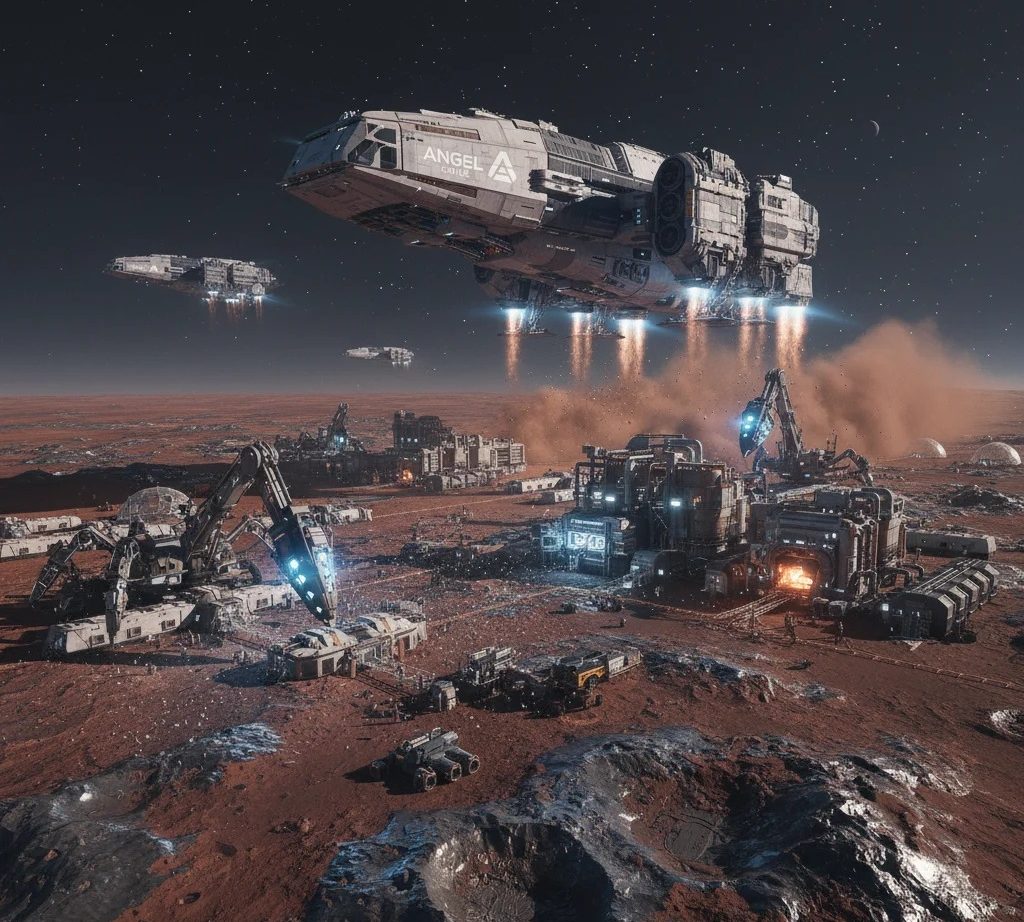
We’re in what I’d call the “transition zone.” The technology is moving from academic papers and sci-fi stories into actual engineering and investor pitch decks. Sample returns have proven we can reach asteroids and bring material back. Robots are being built specifically for microgravity mining. Real companies have real funding and real missions planned.
But industrial-scale asteroid mining is still at least 10 to 15 years away . The technology isn’t mature. The economics are uncertain. The legal framework is a mess.
That said, the trend is undeniable. The global market is growing at over 20% per year. Private companies are entering the space at an accelerating rate. Governments are treating space resources as a strategic priority. In 2023 alone, 2,664 objects were launched into space — a 24% increase from the previous year .
So maybe the better question isn’t “will asteroid mining happen?”
The better question is: when?
Part 8: A Thought to Take Away
For centuries, human civilization has been defined by the resources we could access. The Age of Exploration, the Industrial Revolution, the Oil Age — each one transformed how we live.
Asteroid mining is the next step. It’s a future where we aren’t limited by the resources on Earth. Where we can build in space using space materials. Where we can fuel missions from ice found on a rock millions of kilometers away.
That future isn’t here yet. But for the first time in history, it doesn’t feel like pure fiction anymore.
It feels like something we might actually see — maybe even in our lifetime.
Do you think asteroid mining will happen in the next 20 years? Or is it still science fiction? Let me know in the comments.